

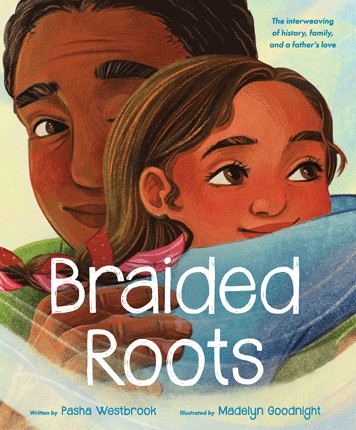
| Braided roots Author: Westbrook, Pasha | ||
| Price: $23.98 | ||
Summary:
As a young girl's father lovingly yet painstakingly braids her hair, he weaves a story about the strength and resilience of their ancestors, Freedmen who walked the Trail of Tears from Mississippi to Oklahoma.
| Illustrator: | Goodnight, Madelyn |
Reviews:
School Library Journal (10/31/25)
Booklist (00/11/25)
The Bulletin of the Center for Children's Books (00/10/25)
Full Text Reviews:
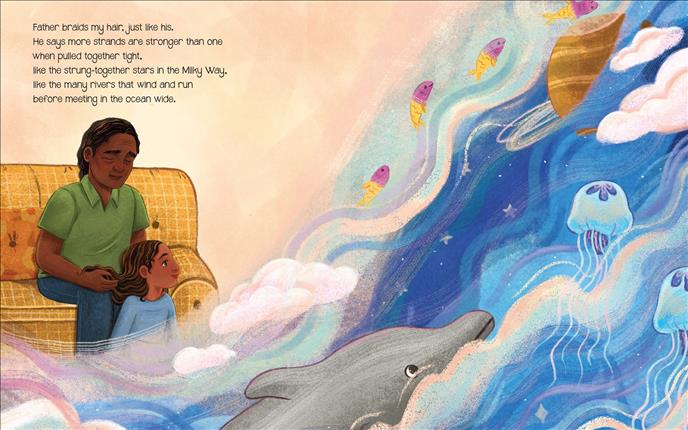
Other - 10/06/2025 In rhythmic text that’s rooted in family history and nature, Chickasaw and Choctaw Freedmen descendant Westbrook begins with an everyday ritual: "Father braids my hair, just like his./ He says more strands are stronger than one/ when pulled together tight." Proceeding pages detail the duo’s family story, referencing photos of ancestors wearing braids ("a DNA chain/ linking me/ back, back, back... to the ones who walked" from Mississippi to Oklahoma). Goodnight’s digitally finished oil and pencil illustrations effectively juxtapose scenes of the past and the present in a work that conveys how "our hair is our history" and how the father’s braid conveys "love in every twist," conferring a deep strength that "might just change the world." Creators’ notes conclude. Ages 4-8. (Nov.) - Copyright 2025
School Library Journal - 10/31/2025 PreS-Gr 2—As a young girl's father lovingly braids her long hair, she reflects on how the braid links her to her close relatives and distant ancestors. As pink and brown ribbons are woven into a girl's brown hair, her father tells her, "Our hair is our story. It tells us who we are, where we come from." She looks at pictures displayed on the wall, including ones of her great-grandparents who "walked that beaten down path from Mississippi to Oklahoma" to her fourth great-grandmother, "enslaved like her ma, owned like her pa." When the braid is done, the girl's father looks on with pride as the girl twirls, her skirt and braid flying. The debut author based the story on her own life, and shares that she is of Black and Native American ancestry, and that some of her relatives were forced out of their homeland to walk the notorious Trail of Tears. Though the story resonates with the bond between a father and a daughter, too many questions are left unanswered for younger readers about the father's pain, walking the trail, and what enslaved means. Without context provided by a caregiver or teacher, the main point of the story is easily overlooked. It's a fine idea, but a somewhat disjointed result. Characters are depicted by Goodnight (Janie Writes a Play: Jane Yolen's First Great Story) with brown skin. Includes an author's note. VERDICT With enough context, this story could work for discussions of difficult, but necessary, topics in U.S. history.—Sue Morgan - Copyright 2025 Publishers Weekly, Library Journal and/or School Library Journal used with permission.


