

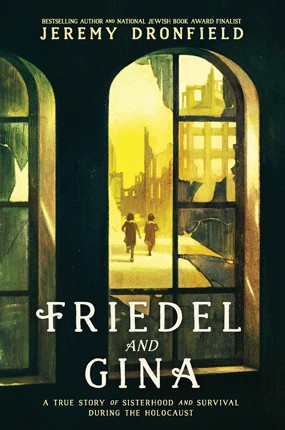
| Friedel and Gina : a true story of sisterhood and survival during the holocaust Author: Dronfield, Jeremy | ||
| Price: $23.28 | ||
Summary:
The true story of Friedel and Gina Rosenthal, twin sisters whose worlds were turned upside down when Adolf Hitler ascended to power.
Reviews:
Kirkus Reviews (03/01/26)
School Library Journal (02/27/26)
Booklist (+) (02/01/26)
Full Text Reviews:
Booklist - 02/01/2026 *Starred Review* Dronfield recounts the harrowing true story of German-born twin sisters Friedel and Regina “Gina” Rosenthal and their struggle to help each other survive the Holocaust during WWII. In 1933, at age nine, Friedel and Gina, the youngest of six children of Jewish Polish–born immigrant parents, found their lives completely upended when Hitler rose to power. The family was arrested, faced miserable living conditions stuck at the border between Germany and Poland, and endured years of starvation in Poland’s Czestochowa ghetto. After the ghetto’s liquidation, the girls were sent to Bergen-Belsen and endured the horror of having to dispose of the bodies of typhus victims. At another camp, Gina, ill with typhus, was saved from certain death after Friedel rescued her from under the Germans’ noses. While the story is true, Dronfield invents a few names and reconstructs some events. However, facts are delineated from fiction in the book’s extensive source notes, including archived interviews with Friedel and her older sister Martha, and firsthand interviews with Friedel, Gina, and Martha’s daughters. The twins’ courage and devotion to each other is inspiring, making this a worthy addition to books about the Holocaust. Includes an author’s note, timeline (not seen), glossary, the aforementioned source notes, bibliography, and further reading. - Copyright 2026 Booklist.
School Library Journal - 02/27/2026 Gr 5–8—This nonfiction narrative details the early lives of Friedel and Gina Rosenthal, Jewish twin sisters from Dusseldorf, Germany, who lived through World War II and survived the Holocaust together. Beginning in 1930, when the girls were six years old, Dronfield juxtaposes the growing rise of Nazism against the steady decline in the Rosenthal family's quality of life. Over the next 15 years, the girls spent their formative days as refugees in Poland, residents of the Czestochowa ghetto, laborers in a work camp, and prisoners in three different concentration camps. Accessible for younger readers, Dronfield painstakingly details every aspect of the girls' experiences while avoiding graphic depictions of especially disturbing incidents. Source notes indicate that Dronfield relied heavily upon interviews with Friedel, recorded in 1995, in his depictions of the girls. While readers can applaud his reluctance to embellish on thoughts or feelings that Friedel herself did not reveal, some may feel he did not go far enough in portraying their personalities or in telling the story through their eyes. For example, Dronfield provides a lengthy visual description of a camp barracks, but in terms of the girls' experiences, he simply writes: "Living in these pits…must have been unimaginably awful." Back matter includes a timeline, glossary, source notes, bibliography, recommended reading, and acknowledgements. VERDICT Full of heartbreaking detail and written with sensitivity, middle school libraries will find this an excellent resource for those wishing to understand the events of the Holocaust.—Jennifer Taylor - Copyright 2026 Publishers Weekly, Library Journal and/or School Library Journal used with permission.


