

BTSB
View MARC Record
 
Text Size:   small mediumlarge
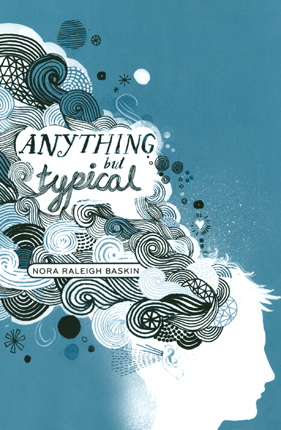
Anything but typical
 Author: Baskin, Nora Raleigh


 Publisher:  Simon & Schuster Books for Young Readers
 Pub Year: 2009

 Classification: Fiction
 Physical Description: 195 p.,  21 cm.

 BTSB No: 095571 ISBN: 9781416963783
 Ages: 10-14 Grades: 5-9

 Subjects:
 Autism -- Fiction
 School stories
 Family life -- Fiction

Courtesy of Brilliance

Price: $17.69

Summary:
Jason, a twelve-year-old autistic boy who wants to become a writer, relates what his life is like as he tries to make sense of his world.

Accelerated Reader Information:
   Interest Level: MG
   Reading Level: 4.10
   Points: 5.0   Quiz: 129385
Reading Counts Information:
   Interest Level: 6-8
   Reading Level: 3.40
   Points: 11.0   Quiz: 45442

Reviews:
 Kirkus Reviews (+) (02/01/09)
 School Library Journal (03/01/09)
 Booklist (+) (02/01/09)
 The Bulletin of the Center for Children's Books (04/09)
 The Hornbook (05/09)

Full Text Reviews:

Booklist - 02/01/2009 *Starred Review* Baskin tells this luminous story entirely from the point of view of Jason, an autistic boy who is a creative-writing whiz and deft explainer of literary devices, but markedly at a loss in social interactions with neurotypicals both at school and at home. He is most comfortable in an online writing forum called Storyboard, where his stories kindle an e-mail-based friendship with a girl. His excitement over having a real friend (and maybe even girlfriend) turns to terror when he learns that his parents want to take him on a trip to the Storyboard conference, where he’ll no doubt have to meet her in person. With stunning economy, Baskin describes Jason’s attempts to interpret body language and social expectations, revealing the extreme disconnect created by his internalization of the world around him. Despite his handicap, Jason moves through his failures and triumphs with the same depth of courage and confusion of any boy his age. His story, while neither particularly heartbreaking nor heartwarming, shows that the distinction between normal and not normal is whisper-thin but easily amplified to create the chasm between different and defective. This is an enormously difficult subject, but Baskin, without dramatics or sentimentality, makes it universal. As Jason explains, there’s really only one kind of plot: Stuff happens. That’s it. - Copyright 2009 Booklist.

School Library Journal - 03/01/2009 Gr 4–7— Baskin writes in the voice of a high-functioning boy who identifies himself as having numerous disorders, most with labels that appear as alphabet soup. In the third grade, after yet another battery of tests, Jason receives the diagnosis of autism. Now in sixth grade, he relates how he does not fit in, even though he tries to follow the instructions of his therapists and helpers. He labels the rest of his classmates and teachers as neurotypicals, or NTs for short. While humor resonates throughout the book, the pathos of Jason's situation is never far from readers' consciousness. If only he could act on what he knows he needs to do, his life would be so much easier. Jason also shows himself to be a deep thinker and an excellent writer. Through his stories and thinly veiled fictional characters, Baskin reveals not only the obstacles that Jason faces, but also his fierce determination to be himself at all costs. Jason is a believable and empathetic character in spite of his idiosyncrasies. Baskin also does a superb job of developing his parents and younger brother as real people with real problems, bravely traversing their lives with a differently abled child without a road map, but with a great deal of love.—Wendy Smith-D'Arezzo, Loyola College, Baltimore, MD - Copyright 2009 Publishers Weekly, Library Journal and/or School Library Journal used with permission.

Bulletin for the Center... - 04/01/2009 Other kids see Jason as weird: the sixth-grader spends time in special ed (he’s diagnosed with PPD-NOS, a disorder related to autism), he doesn’t relate well to other people, and he’s easily upset when faced with the uncontrolled or unexpected (“It is pretty much a matter of time before the first thing of the day will go wrong”). It’s a different matter on the internet, however, where Jason posts his writing on a site called Storyboard, and where he’s corresponding with Rebecca, a girl who likes his work. When he gets the chance to attend a countrywide meetup for young Storyboard users, though, he fears that Rebecca will reject him if they meet face to face, and he’ll lose this treasured friendship. Jason’s viewpoint focuses a great deal on the reactions and emotions of other people, which on the one hand contrasts oddly with his social difficulty (and brings his mother a little excessively to the foreground) but on the other helps readers empathize with his isolation. Baskin skillfully conveys the way Jason sees and responds to the world, rendering what could be perplexing reactions understandable, and his writing offers an additional window into his psyche. Perhaps most touching of all isn’t his relationship with Rebecca but his closeness with Jeremy, his younger brother, who matter-of-factly reads and accepts Jason’s behaviors and looks up to his big bro. While other spectrum-disorder kids may see themselves in Jason, the book is particularly skilled at translating his reality for those who may not otherwise understand it, so it will be an eye-opening experience for many neurotypical young readers. DS - Copyright 2009 The Board of Trustees of the University of Illinois.


View MARC Record
Loading...